
Choose a language:


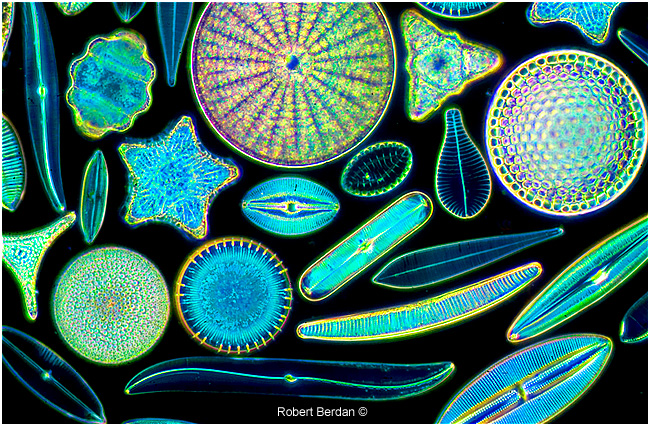
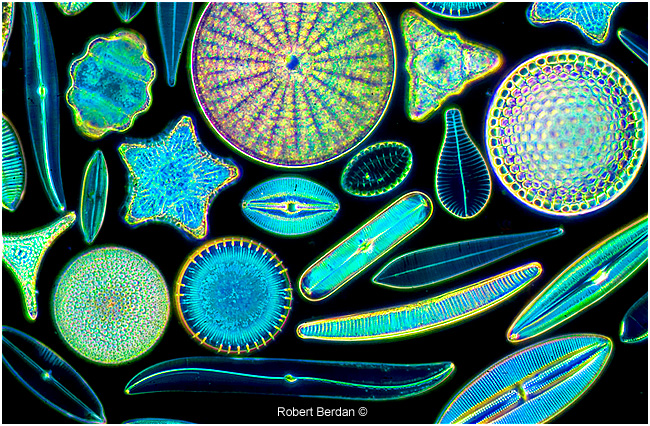
Derived from the Greek words phyto (plant) and plankton (made to wander or drift), phytoplankton are microscopic organisms that live in watery environments, both salty and fresh. Like land plants, phytoplankton have chlorophyll to capture sunlight, and they use photosynthesis to turn it into chemical energy. They consume carbon dioxide, and release oxygen. All phytoplankton photosynthesize, but some get additional energy by consuming other organisms. Phytoplankton growth depends on the availability of carbon dioxide, sunlight, and nutrients. Phytoplankton, like land plants, require nutrients such as nitrate, phosphate, silicate, and calcium at various levels depending on the species. Some phytoplankton can fix nitrogen and can grow in areas where nitrate concentrations are low. They also require trace amounts of iron which limits phytoplankton growth in large areas of the ocean because iron concentrations are very low. Phytoplankton cause mass mortality in other ways. In the aftermath of a massive bloom, dead phytoplankton sink to the ocean or lake floor. The bacteria that decompose the phytoplankton deplete the oxygen in the water, suffocating animal life; the result is a dead zone.
Local name
Fitoplankton
English name
Phytoplankton
Scientific name
Phytoplankton
Did you know?
Phytoplankton produce half of the world's oxygen.
Weight
-
Length
-
Life span
-
Nutrition
Phytoplankton obtain their energy through photosynthesis, as do trees and other plants on land.
Type of diet
Autotrophic
IUCN vulnerability status
Not Assessed (IUCN Red List)